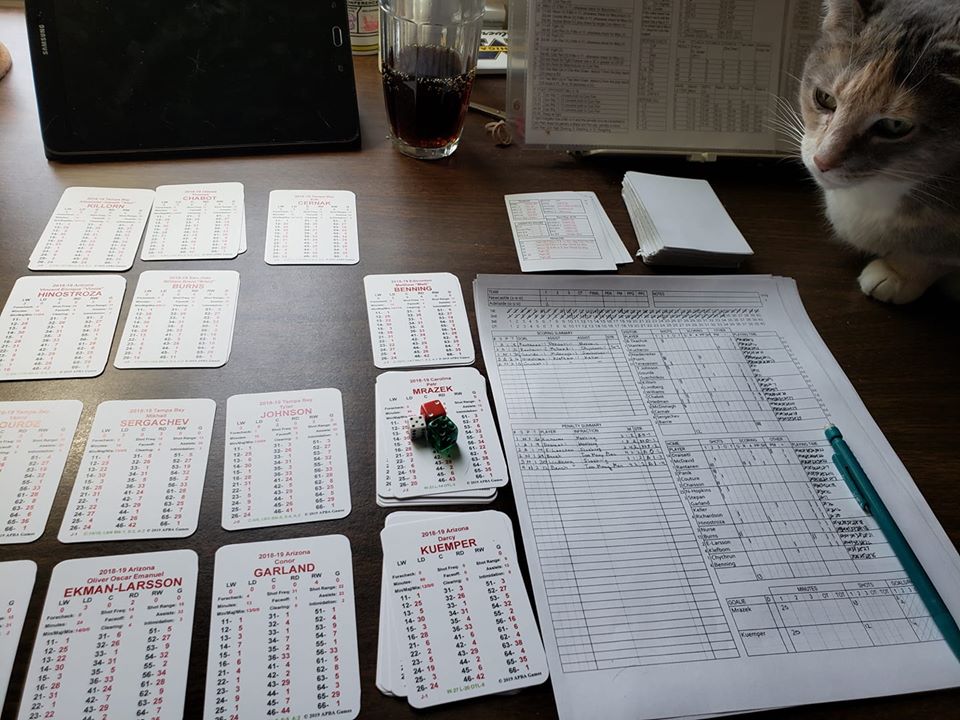
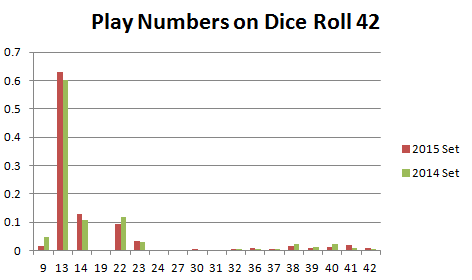
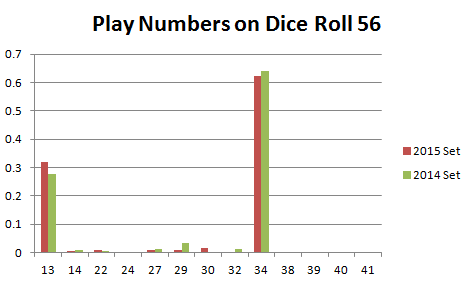
I purchased a 1929-30 hockey set to play around with. You know, the original 10. Yes, the NHL before the “Original 6” had 10 teams, with second franchises in Montreal and New York, plus teams in Ottawa and Pittsburgh. Over the 30s and 40s, one by one those teams vanished, and the league because they were greedy decided 1/6th of a share is better than 1/10th, and did not expand for 25 years.
Once we get past the heartbreak of learning the Original 6 was a lie, you then have to contend with the game being somewhat different in the 1929-30 season than what we see today. Here are some basic differences:
- Before the season, it was forbidden to pass the puck forward to in the offensive zone. It had to be carried in at the blue line. However, there was no restriction on where the other players could be. After a low scoring 1928-29 season, the NHL allowed forward passing in the offensive zone. This proved to be too much, as teams learned to just have someone near the goalie ready to take a pass once the player crossed the blue line. So six weeks into the season, the league added an element that is close to the offside rule of today, that the player carrying the puck must be the first one in the offensive zone.
- There was no stoppage for icing the puck. That did not come for a few more years.
- Penalties had to be served without substitution. So if two players were in a fight, it became 4-on-4. And if another fight happened 4-on-4, you could go down to 3-on-3. The minimum amount of skaters on the ice was two instead of three, so you could have 5-on-2 or 2-on-2 situations.
- Scoring on a power play did not cancel the remainder of the time, so it was possible to score multiple goals even on minor penalties.
- Although up to four assists could be awarded on a goal, although rarely more than one was awarded.
- Most teams dressed only 12 skaters and one goalie. The usual breakdown was eight forwards and four d-men. Most of the teams had a forward or two who could also play the blue line.
- Overtime periods (5×5) were 10 minutes in length. Also no shootouts.
There are some inherent challenges with playing an old time set. Stats at the time were simply goals, assists, and penalties. And only the goals had a timestamp, penalties were just listed by period or sometimes there would be one list for the whole game. So this makes save percentages, power play chances, and shorthanded goals not reproducible to a 1929-30 level, because we don’t know what that level is.
So I played a double-elimination tournament. As expected, the Boston Bruins cruised and won. You know, Eddie Shore, old-time hockey and all that. However, after a few games I noticed that:
- Goals were way too low. Shots probably were as well, but we cannot prove that. I saw an average of 23 shots per team for a game.
- There were too many penalties being called.
- Power play chances were not converting at a higher rate than even strength chances.
So in trying to fix those issues plus incorporate the differences in rules, I came up with the following adjustments to the regular rules:
- Shooting Changes:
- Consider all dice rolls of 34, which normally result in play result 31, to be a shot.
- Add 1 to all shot range numbers.
- For play results 31 and 32 that check for Intimidation, add 4 to the threshold number. So something like INT-10 becomes INT-14. The players have comically high Intimidation ratings and it was almost impossible for those numbers to be shots.
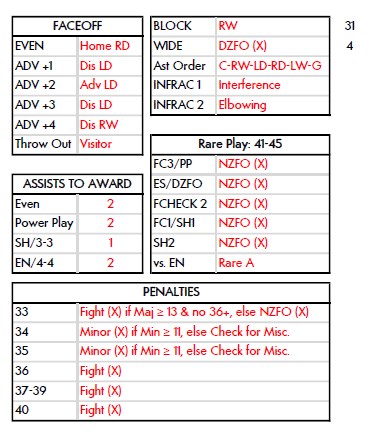
- Penalty Changes: The ratio of minors vs. majors was not readily available when this set was made unless you were going to research every boxscore. Since then, those have been tabulated and in retrospect the Major ratings were set way too high. To limit the amount of majors, do the following:
- Do not check for a major on play result 33.
- On a play result of 36, it is only a major if a reroll is between 11-26, otherwise consider them coincidental minors.
- On play results of 37-39, it is like the change in play result 36 above except the reroll range is 11-36.
- On play result 40, do the same as above except the reroll range is 11-46.
- Other Changes:
- Change all play results of 30 where it would be an icing to INT-RD. Keep the 30 as is for penalty killing.
- When awarding assists, subtract one from the roll that determines if you give one or two assists except if the roll is 11 or 12, those should stay as two assists.
In managing a much smaller bench, I found it best to essentially make two groups of six with 4 F and 2 D, rotating out a forward or in a few instances a defenseman. Change at the first stoppage at or after 12 play sequences, so basically becomes Group A playing twice in the first and third periods and once in the second, and Group B playing once in the first and third periods and twice in the second. I also found it somewhat pointless to make separate PP and PK lines like I do in a normal season. I just simply kept the players on the ice when a penalty was called, and just removed the offending player.
Most forwards are going to be rated for 24-29 minutes, and most d-men for 28-32. Boston was a little different since their top 3 d-men could play 108 minutes between them, so I made one of the groups a group of 4 F, 2D, and 1 F/D, with the latter playing on defense one or two shifts.
I think by making these changes you will find the game to be more realistic to the hockey played 100 years ago, even if we don’t have the stats or the video evidence to prove it.